
TV Mounting Coast Huntington Beach: Condo and Townhome TV Mounting in Huntington Beach
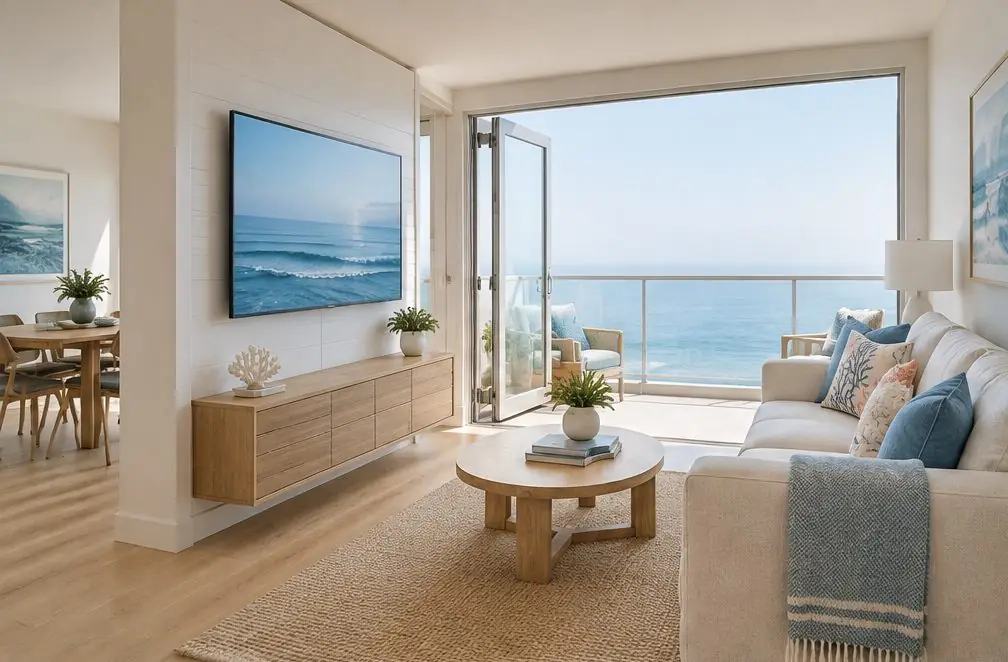
TV Mounting Coast Huntington Beach covers TV mounting in Huntington Beach condos and townhomes — newer buildings downtown and along Pacific Coast Highway, townhome communities inland, and older garden-style complexes — where the framing may be steel or wood, the living-room wall may be shared with a neighbor, and the association often has rules about balconies and drilling hours.
Bookings aren't open yet. Leave your name and number; your message is recorded, and you'll get one message when a local installer is available.
 Illustration
Steel or wood: confirming the framing
Condo buildings in Huntington Beach use both wood and light-gauge steel framing, sometimes in the same building. A metal-sensing stud finder and a small probe hole settle which, and the anchoring follows.
| Framing found | Anchoring | Notes |
|---|---|---|
| Wood studs | 5/16 in lag bolts into two studs | Same as a house |
| Steel studs | Rated toggles through the stud flange | Lag bolts strip out in steel |
| Steel studs, large TV or full-motion arm | Wood backer plate across two studs, mount bolted to the backer | Spreads the leverage |
| Concrete wall | Sleeve or wedge anchors | Common at podium levels and stair cores |
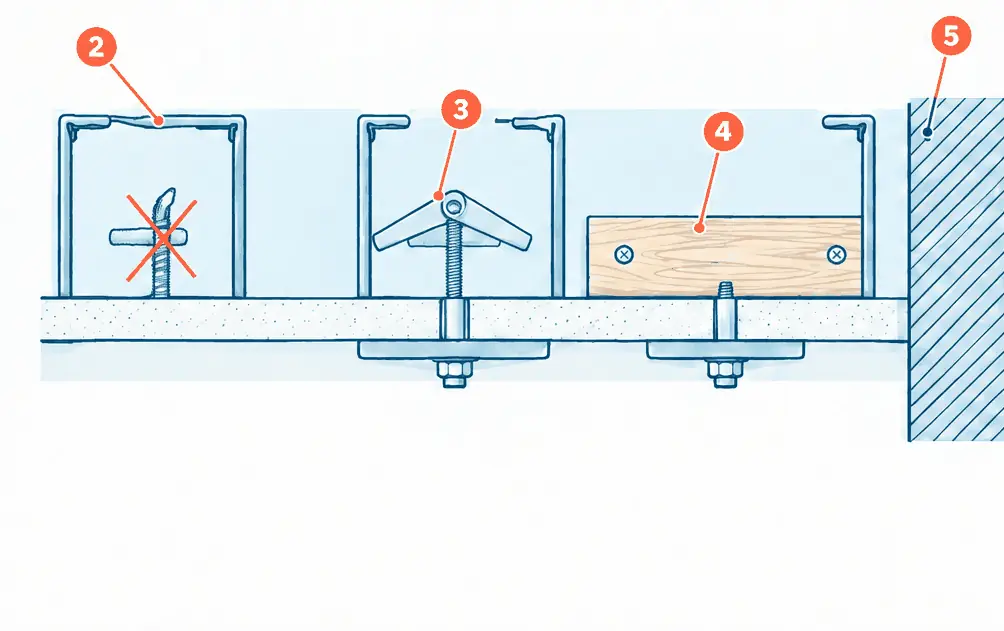
What the numbers show
- C-shaped steel stud Light-gauge steel studs are hollow channels with a thin face; a lag bolt has almost nothing to bite into.
- Lag bolt does not hold Threads strip in the thin steel, so a lag bolt alone is not used on a steel stud.
- Toggle through the stud face A toggle anchor passes through the stud's face and opens inside the channel, clamping the plate to the stud.
- Backer board A wood or metal backer screwed across several studs gives the mount a solid base and spreads the load.
- Party wall In condos and townhomes, holes in a shared wall are often limited by the CC&Rs; the mount then goes on an interior partition.
Shared walls, balconies and the CC&Rs
Condo and townhome CC&Rs often limit holes in shared (party) walls and anything attached to a balcony or exterior wall. Where that applies, the mount goes on an interior partition and outdoor TVs stay off common-area surfaces. The association's rules decide.
Many associations also set quiet hours for drilling; a mid-morning slot keeps an install inside them in most buildings.
Getting in and out of the building
- Parking — guest spaces or a loading zone for a large TV box.
- Elevators — usually fine for a TV box; some buildings ask for moves to be scheduled.
- Hallways — protected when a large box is carried through.
- Trash — the box and foam leave with the installer or go to the building's recycling as its rules say.
In a condo, choosing the right wall is half of the install.
Wires without opening a shared wall
On an interior partition an in-wall rated power relocation kit and HDMI can hide the cables. On a shared wall, a slim raceway painted to the wall, or a console placed right under the screen, keeps it tidy without a penetration.
Condo & Townhome TV Mounting — common questions
How much does TV mounting cost in a Huntington Beach condo?
On steel studs about $134–$194 for a 32–49 inch TV and $154–$224 for 50–65 inches in 2026; on wood studs the regular base range applies.
Can a TV go on a condo balcony?
Only where the CC&Rs allow anything on balconies or exterior walls; many do not. The association's rules decide.
Condo & Townhome TV Mounting: check availability and price range
Bookings aren't open yet — tap what fits your TV and wall and get a typical Huntington Beach price range right here. Typical Huntington Beach prices for one TV, labor only unless an option says otherwise. This is a market estimate, not a quote.